1. A properly designed and well built system is key to good handling and reducing stress on your cattle. There are some building basics and details that animal behaviorists have identified as necessary for designs that minimize stress in cattle. Top on this list is a handling system that uses curves. www.grandinlivestockhandlingsystems.com1
1. A properly designed and well built system is key to good handling and reducing stress on your cattle. There are some building basics and details that animal behaviorists have identified as necessary for designs that minimize stress in cattle. Top on this list is a handling system that uses curves. www.grandinlivestockhandlingsystems.com
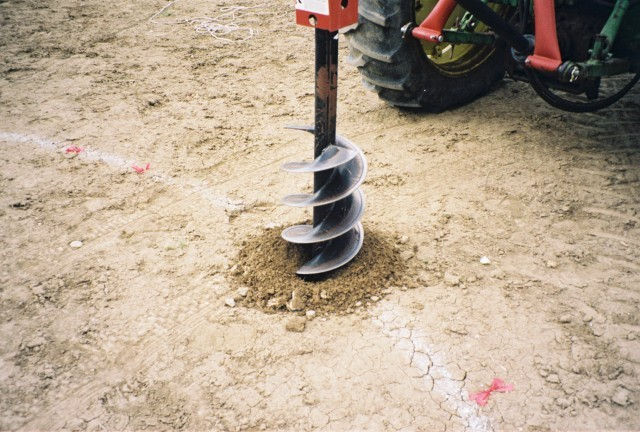
2. After you lay out your new facility on the ground (see layout examples), mark the position on the ground for each post and begin digging the holes. It is easy to accurately dig a hole in the correct location by centering the posthole digger over the nail with the colored flagging attached to it. Dig the holes 30 inches (76cm) deep in 10-to12 inch (25 to 30cm) diameter holes and set the posts in concrete. Pour concrete in the hole then lift the post so there are 6 inches (15cm) of concrete below the bottom of the post. www.grandinlivestockhandlingsystems.com
2
2. After you lay out your new facility on the ground (see layout examples), mark the position on the ground for each post and begin digging the holes. It is easy to accurately dig a hole in the correct location by centering the posthole digger over the nail with the colored flagging attached to it. Dig the holes 30 inches (76cm) deep in 10-to12 inch (25 to 30cm) diameter holes and set the posts in concrete. Pour concrete in the hole then lift the post so there are 6 inches (15cm) of concrete below the bottom of the post. www.grandinlivestockhandlingsystems.com
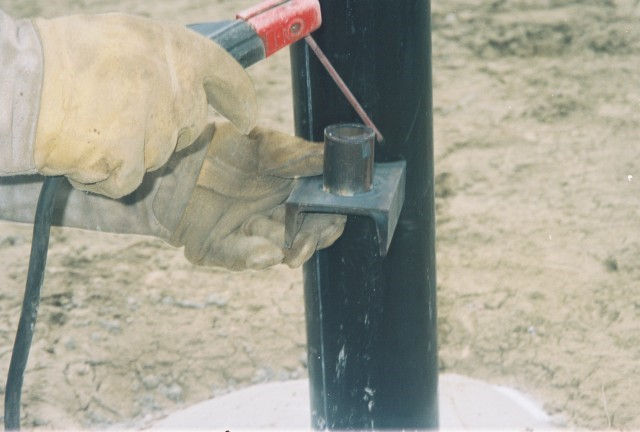
3. When building the channel iron hinge, cut a hole in the channel and weld the pipe sleeve to the bottom of the channel. The gate must not pivot against the welding bead. Weld the bottom 3-inch (8cm) wide channel gate to the gatepost. The pipe that forms the gate frame will fit over the 2-inch (5cm) pipe sleeve welded to the channel iron. The top hinge is made the same way as the bottom hinge except it is inverted, and the pipe sleeve is inserted into the top of the gate frame. www.grandinlivestockhandlingsystems.com
3
3. When building the channel iron hinge, cut a hole in the channel and weld the pipe sleeve to the bottom of the channel. The gate must not pivot against the welding bead. Weld the bottom 3-inch (8cm) wide channel gate to the gatepost. The pipe that forms the gate frame will fit over the 2-inch (5cm) pipe sleeve welded to the channel iron. The top hinge is made the same way as the bottom hinge except it is inverted, and the pipe sleeve is inserted into the top of the gate frame. www.grandinlivestockhandlingsystems.com
4. Build the gate and hang the gate. When laying out the posts for the round crowd pen, the crowd gate can be employed as a compass to accurately place your posts. www.grandinlivestockhandlingsystems.com4
4. Build the gate and hang the gate. When laying out the posts for the round crowd pen, the crowd gate can be employed as a compass to accurately place your posts. www.grandinlivestockhandlingsystems.com
5. Prepare the posts for the round crowd pen. Crimping the top of a fence post allows the top rail to be welded on without having to make time-consuming curved saddle cuts. Heat the end of the post with a torch to soften it before using the hammer, or crimp with a hydraulic press. When using a hydraulic press go slowly to prevent splitting the end of the post. www.grandinlivestockhandlingsystems.com5
5. Prepare the posts for the round crowd pen. Crimping the top of a fence post allows the top rail to be welded on without having to make time-consuming curved saddle cuts. Heat the end of the post with a torch to soften it before using the hammer, or crimp with a hydraulic press. When using a hydraulic press go slowly to prevent splitting the end of the post. www.grandinlivestockhandlingsystems.com
6. The 12-foot (3.6m) crowd gate is used as a compass to determine the precise post locations of the half-circle crowd pen so that a 2-inch (5cm) gap is maintained between the end of the gate and the fence posts. www.grandinlivestockhandlingsystems.com6
6. The 12-foot (3.6m) crowd gate is used as a compass to determine the precise post locations of the half-circle crowd pen so that a 2-inch (5cm) gap is maintained between the end of the gate and the fence posts. www.grandinlivestockhandlingsystems.com
7. The hinges should be welded on the correct location so the crowd gate will swing completely open and lay flat back against the fence. www.grandinlivestockhandlingsystems.com
7
7. The hinges should be welded on the correct location so the crowd gate will swing completely open and lay flat back against the fence. www.grandinlivestockhandlingsystems.com
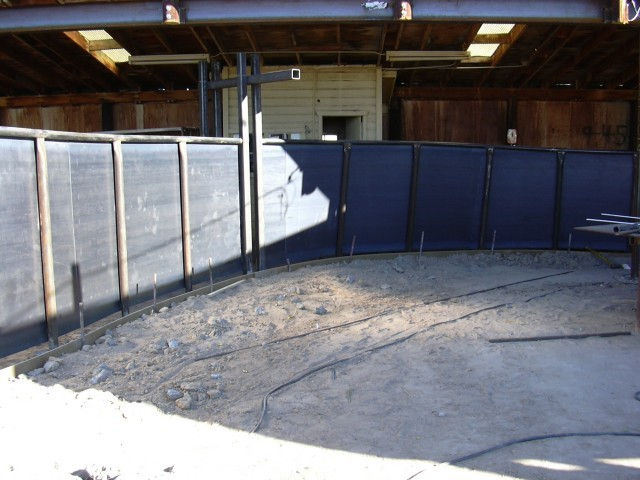
8. All posts in the half-circle crowd pen are placed on 4-foot (1.2m) centers. www.grandinlivestockhandlingsystems.com8
8. All posts in the half-circle crowd pen are placed on 4-foot (1.2m) centers. www.grandinlivestockhandlingsystems.com
9. Weld the top rail on the entire curved fence. Use lengths of 2-inch (5cm) pipe in 21 foot long sections. Heat the pipe with torch-heating tip pulled around to each post. You can also roll the pipe at a machine shop to fit the radius of the curved fence. Many large machine shops or welding shops have pipe rolling equipment. www.grandinlivestockhandlingsystems.com
9
9. Weld the top rail on the entire curved fence. Use lengths of 2-inch (5cm) pipe in 21 foot long sections. Heat the pipe with torch-heating tip pulled around to each post. You can also roll the pipe at a machine shop to fit the radius of the curved fence. Many large machine shops or welding shops have pipe rolling equipment. www.grandinlivestockhandlingsystems.com
10. Dig the holes for the V-shaped single file chute. An old ax head welded to the end of a digging bar works well for digging a rectangular hole that the V-section can be set into. www.grandinlivestockhandlingsystems.com
10
10. Dig the holes for the V-shaped single file chute. An old ax head welded to the end of a digging bar works well for digging a rectangular hole that the V-section can be set into. www.grandinlivestockhandlingsystems.com
11. To maintain accurate dimensions on the V-shaped single file chute, use a jig made from a sheet of plywood with pieces of wood nailed in to hold the pipes in place. The welded jig bars maintain the V-shaped assembly in the correct dimensions. www.grandinlivestockhandlingsystems.com
11
11. To maintain accurate dimensions on the V-shaped single file chute, use a jig made from a sheet of plywood with pieces of wood nailed in to hold the pipes in place. The welded jig bars maintain the V-shaped assembly in the correct dimensions. www.grandinlivestockhandlingsystems.com
12. A slot is cut into the edge of the plywood so that the crimped end of the post will stand upright and can be lined up with the direction of the fence. www.grandinlivestockhandlingsystems.com12
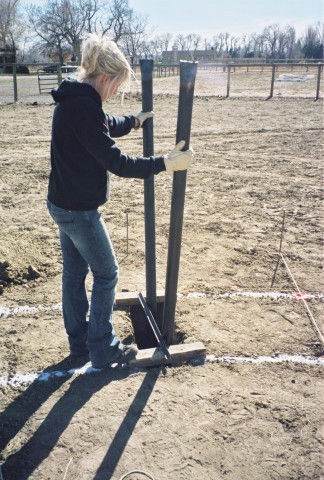
12. A slot is cut into the edge of the plywood so that the crimped end of the post will stand upright and can be lined up with the direction of the fence. www.grandinlivestockhandlingsystems.com
13. Line up the V-jig with the string. Each of the jigs is placed on 4-foot (1.2m) centers along the outside radius of the line. www.grandinlivestockhandlingsystems.com
13
13. Line up the V-jig with the string. Each of the jigs is placed on 4-foot (1.2m) centers along the outside radius of the line. www.grandinlivestockhandlingsystems.com
14. The V-jig bar can rest on wooden blocks or bricks to hold the V-section in the correct position when the hole is filled with concrete. www.grandinlivestockhandlingsystems.com
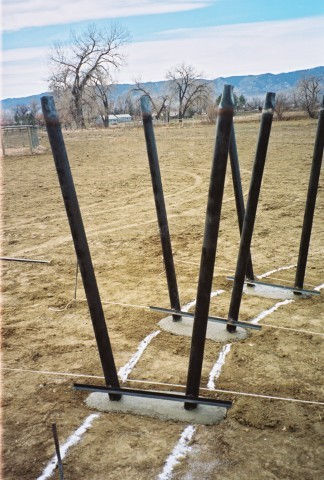
14
14. The V-jig bar can rest on wooden blocks or bricks to hold the V-section in the correct position when the hole is filled with concrete. www.grandinlivestockhandlingsystems.com
15. The V-sections have been set and they are lined up like bicycle spokes with strings tied to the center point of the 16-foot (4.8m) radius of the curved single-file chute. The top jig bars will be buried in the concrete floor and do not have to be removed. www.grandinlivestockhandlingsystems.com15
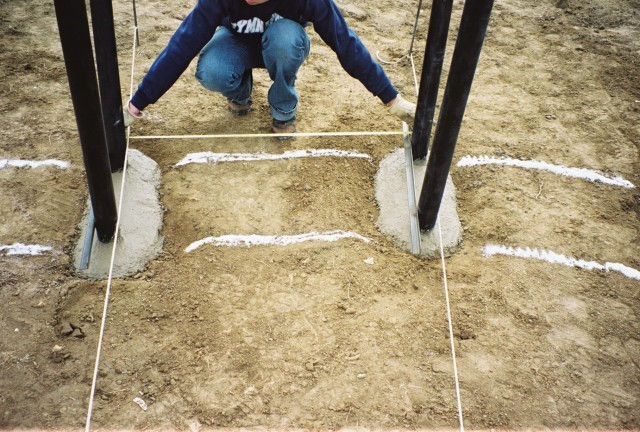
15. The V-sections have been set and they are lined up like bicycle spokes with strings tied to the center point of the 16-foot (4.8m) radius of the curved single-file chute. The top jig bars will be buried in the concrete floor and do not have to be removed. www.grandinlivestockhandlingsystems.com
16. Make sure the top jig bar is above ground level and the posts on the outside radius are on 4-foot (1.2m) centers. www.grandinlivestockhandlingsystems.com16
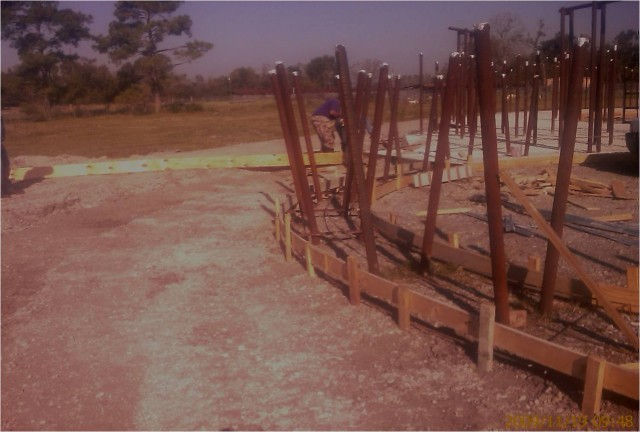
16. Make sure the top jig bar is above ground level and the posts on the outside radius are on 4-foot (1.2m) centers. www.grandinlivestockhandlingsystems.com
17. From the ground level, the top of the V-shaped single file must be 5-foot 6-inches (1.5m 15 cm). This allows enough height so 6-inches (15cm) of concrete slab can be poured leaving a 5-foot (1.5m) overall height to the fence. www.grandinlivestockhandlingsystems.com
17
17. From the ground level, the top of the V-shaped single file must be 5-foot 6-inches (1.5m 15 cm). This allows enough height so 6-inches (15cm) of concrete slab can be poured leaving a 5-foot (1.5m) overall height to the fence. www.grandinlivestockhandlingsystems.com
18. Build the forms for all the concrete flatwork in 4-foot (1.2m) straight sections that are 6-inches (15cm) to the outside of the posts to create a curb. www.grandinlivestockhandlingsystems.com
18
18. Build the forms for all the concrete flatwork in 4-foot (1.2m) straight sections that are 6-inches (15cm) to the outside of the posts to create a curb. www.grandinlivestockhandlingsystems.com
19.After setting the posts and building the forms for the crowd pen, single-file chute, and the wide curved lane, pour the concrete floors. A 6-inch (15cm) deep concrete slab is recommended. Use 3500 psi concrete for a top quality floor slab. www.grandinlivestockhandlingsystems.com19
19.After setting the posts and building the forms for the crowd pen, single-file chute, and the wide curved lane, pour the concrete floors. A 6-inch (15cm) deep concrete slab is recommended. Use 3500 psi concrete for a top quality floor slab. www.grandinlivestockhandlingsystems.com
20. Reinforce concrete flatwork (floor slabs) with 6-6-10-10 welded wire mesh throughout. www.grandinlivestockhandlingsystems.com20
20. Reinforce concrete flatwork (floor slabs) with 6-6-10-10 welded wire mesh throughout. www.grandinlivestockhandlingsystems.com
21. To achieve proper grooving, it is important not to pour too much concrete at once or the concrete will become too hard to groove. Four to six yards (about a third to half of a large mixer truck) is recommended. www.grandinlivestockhandlingsystems.com
21
21. To achieve proper grooving, it is important not to pour too much concrete at once or the concrete will become too hard to groove. Four to six yards (about a third to half of a large mixer truck) is recommended. www.grandinlivestockhandlingsystems.com
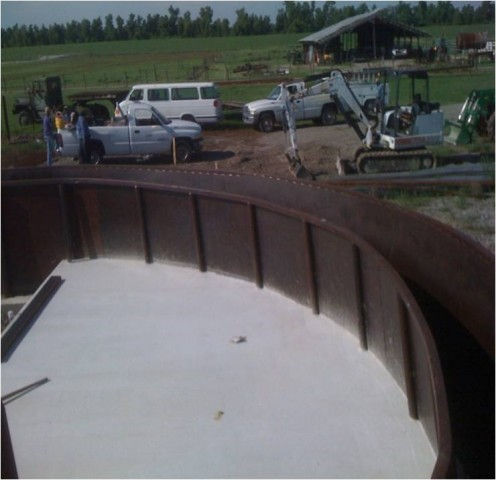
22. A raised concrete walking platform is most efficient. Both catwalks and raised concrete platforms are placed 42-inches (107cm) down from the top of the 5-foot (1.5m) high solid fence. Catwalks and raised platforms less than 2-feet (0.6m) off the ground do not need hand rails per OSHA regulations. www.grandinlivestockhandlingsystems.com
22
22. A raised concrete walking platform is most efficient. Both catwalks and raised concrete platforms are placed 42-inches (107cm) down from the top of the 5-foot (1.5m) high solid fence. Catwalks and raised platforms less than 2-feet (0.6m) off the ground do not need hand rails per OSHA regulations. www.grandinlivestockhandlingsystems.com
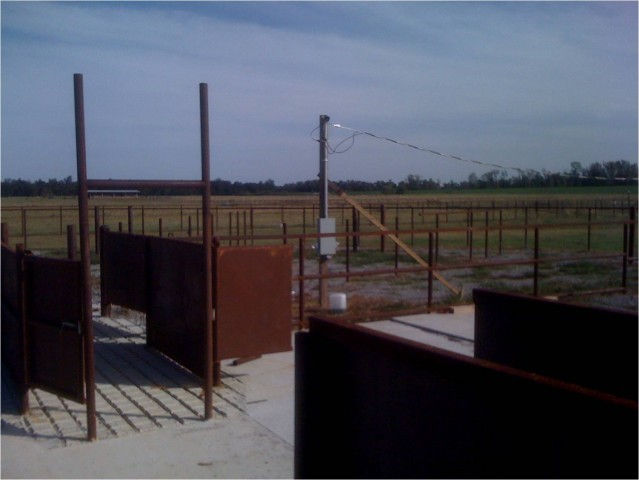
23. In all facilities, handlers must perform movement patterns alongside the single-file chute to move the animals. These handling patterns are more difficult to make on a catwalk than on a raised concrete platform. www.grandinlivestockhandlingsystems.com
23
23. In all facilities, handlers must perform movement patterns alongside the single-file chute to move the animals. These handling patterns are more difficult to make on a catwalk than on a raised concrete platform. www.grandinlivestockhandlingsystems.com
24. It is important to groove the concrete at the area where cattle exit the squeeze chute to prevent slipping and falling. www.grandinlivestockhandlingsystems.com
24
24. It is important to groove the concrete at the area where cattle exit the squeeze chute to prevent slipping and falling. www.grandinlivestockhandlingsystems.com
25. Use a modified bull float for grooving the concrete to provide nonslip footing for cattle and bison. Pour a test pad and learn to use this tool before pouring the floor. www.grandinlivestockhandlingsystems.com
25
25. Use a modified bull float for grooving the concrete to provide nonslip footing for cattle and bison. Pour a test pad and learn to use this tool before pouring the floor. www.grandinlivestockhandlingsystems.com
26. The modified float is made by attaching 1-1/2-inch (3.8cm) wide angle iron sections cut to the width of the float. Heat the ends of the angle iron and pinch them together to form what resembles a canoe. Weld two ¼-inch by 1-inch (0.63cm by 2.54cm) bolts to the center of the angle iron canoe. The angle-iron pieces are spaced on the bull float 8-inches (20cm) apart and mounted using washers and nuts. www.grandinlivestockhandlingsystems.com26
26. The modified float is made by attaching 1-1/2-inch (3.8cm) wide angle iron sections cut to the width of the float. Heat the ends of the angle iron and pinch them together to form what resembles a canoe. Weld two ¼-inch by 1-inch (0.63cm by 2.54cm) bolts to the center of the angle iron canoe. The angle-iron pieces are spaced on the bull float 8-inches (20cm) apart and mounted using washers and nuts. www.grandinlivestockhandlingsystems.com
27. Concrete has to be worked at just the right consistency to ensure proper grooves. If the concrete is too dry, the float will not rest on the concrete surface and the grooves will be too shallow. If the concrete is at the right consistency (not too wet, not too dry), one pass with the float is all that is needed. www.grandinlivestockhandlingsystems.com
27
27. Concrete has to be worked at just the right consistency to ensure proper grooves. If the concrete is too dry, the float will not rest on the concrete surface and the grooves will be too shallow. If the concrete is at the right consistency (not too wet, not too dry), one pass with the float is all that is needed. www.grandinlivestockhandlingsystems.com
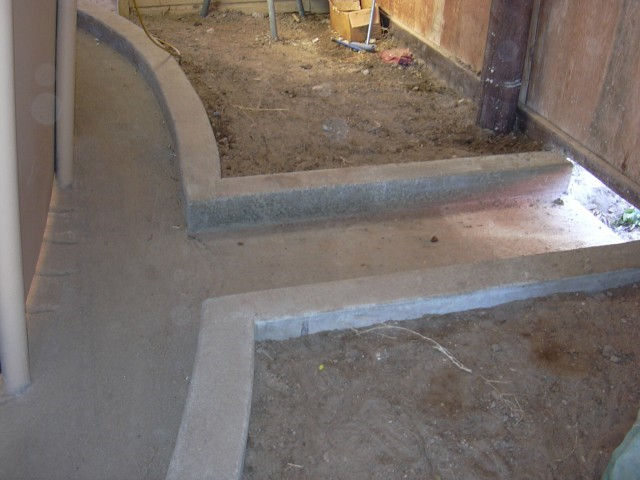
28. A hand held grooving tool for finishing the edges and corners of concrete floors is made from a piece of angle iron with pinched ends. www.grandinlivestockhandlingsystems.com
28
28. A hand held grooving tool for finishing the edges and corners of concrete floors is made from a piece of angle iron with pinched ends. www.grandinlivestockhandlingsystems.com
29. Washout gutter for easy wash down of the single-file chute; note that the manure is contained in a small area. A 2-inch (5cm) gap is left under the 10-gauge steel sheet. Do not make a larger gap or serious foot injury may result. www.grandinlivestockhandlingsystems.com
29
29. Washout gutter for easy wash down of the single-file chute; note that the manure is contained in a small area. A 2-inch (5cm) gap is left under the 10-gauge steel sheet. Do not make a larger gap or serious foot injury may result. www.grandinlivestockhandlingsystems.com
30. Build the forms for the washout gutter by extending the floor slab forms 24-inches (60cm) past the fence in 4-foot (1.2m) straight sections, or curved sections of flexible form material. www.grandinlivestockhandlingsystems.com
30
30. Build the forms for the washout gutter by extending the floor slab forms 24-inches (60cm) past the fence in 4-foot (1.2m) straight sections, or curved sections of flexible form material. www.grandinlivestockhandlingsystems.com
31. Before pouring the concrete floor of the washout gutter, drive ½-inch (1.3cm) diameter reinforcing rods in the ground 3-inches (7.6cm) inside the forms and 24-inches (60cm) apart. The rods should extend 5-inches (12.7cm) above the top of the washout gutter floor slab. These rods will serve as the reinforcement for the washout gutter, located outside the fence on the outer perimeter of the washout gutter. Broom finish the washout gutter and all areas where people walk. www.grandinlivestockhandlingsystems.com
31
31. Before pouring the concrete floor of the washout gutter, drive ½-inch (1.3cm) diameter reinforcing rods in the ground 3-inches (7.6cm) inside the forms and 24-inches (60cm) apart. The rods should extend 5-inches (12.7cm) above the top of the washout gutter floor slab. These rods will serve as the reinforcement for the washout gutter, located outside the fence on the outer perimeter of the washout gutter. Broom finish the washout gutter and all areas where people walk. www.grandinlivestockhandlingsystems.com
32. For easy washout of manure from the single-file chute, slope the concrete in the washout gutter floor ¼-inch (0.6cm) per foot away from the outside radius of the fence. www.grandinlivestockhandlingsystems.com
32
32. For easy washout of manure from the single-file chute, slope the concrete in the washout gutter floor ¼-inch (0.6cm) per foot away from the outside radius of the fence. www.grandinlivestockhandlingsystems.com
33. For easy washout of manure from the single-file chute, make single grooves 1 ½-inch (3.8cm) wide and 1 ½-inches (3.8cm) deep  grooves  8-inches (20cm) apart. Angle the grooves like spokes on a bicycle to direct water towards the washout gutter. Note; the washout drain can be located anywhere along the outside radius of the single-file chute. www.grandinlivestockhandlingsystems.com
33
33. For easy washout of manure from the single-file chute, make single grooves 1 ½-inch (3.8cm) wide and 1 ½-inches (3.8cm) deep grooves 8-inches (20cm) apart. Angle the grooves like spokes on a bicycle to direct water towards the washout gutter. Note; the washout drain can be located anywhere along the outside radius of the single-file chute. www.grandinlivestockhandlingsystems.com
34. On the opposite side of the fence from the washout gutter and drain, build the forms 6-inches (15cm) to the outside of the posts to create a curb. www.grandinlivestockhandlingsystems.com
34
34. On the opposite side of the fence from the washout gutter and drain, build the forms 6-inches (15cm) to the outside of the posts to create a curb. www.grandinlivestockhandlingsystems.com
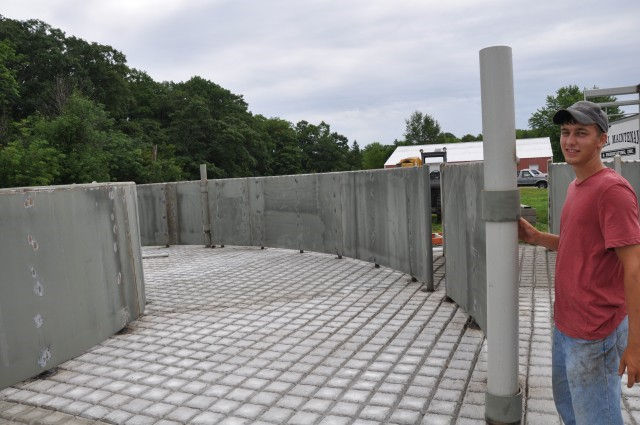
35. Proper grooving of the concrete is essential to prevent cattle from falling. A rough broom finish wears out too quickly and is not recommended for any species (other than humans). One area where deep grooved concrete is especially important is the exit area from the squeeze chute (as shown in this picture). Many cattle have a tendency to jump then run when released from the squeeze chute (crush). www.grandinlivestockhandlingsystems.com
35
35. Proper grooving of the concrete is essential to prevent cattle from falling. A rough broom finish wears out too quickly and is not recommended for any species (other than humans). One area where deep grooved concrete is especially important is the exit area from the squeeze chute (as shown in this picture). Many cattle have a tendency to jump then run when released from the squeeze chute (crush). www.grandinlivestockhandlingsystems.com
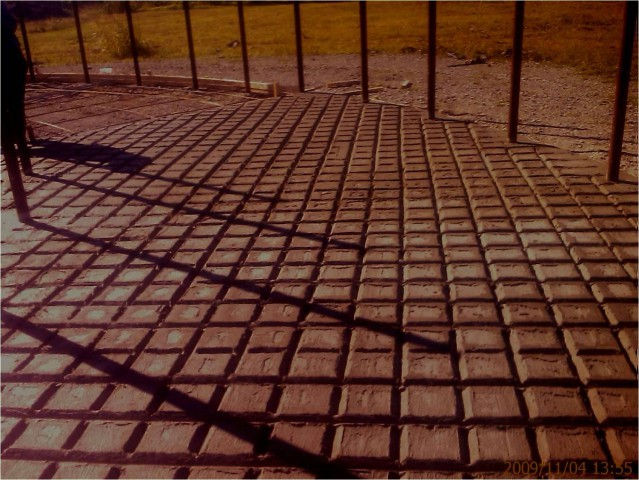
36. Deep groove concrete in all areas where cattle walk. Use 8-inch (20cm) diamond pattern grooves that are 1 ½-inches (3.8cm) deep and 1-1/2-inches (3.8cm) wide. The diamond pattern should be in the direction cattle travel. www.grandinlivestockhandlingsystems.com
36
36. Deep groove concrete in all areas where cattle walk. Use 8-inch (20cm) diamond pattern grooves that are 1 ½-inches (3.8cm) deep and 1-1/2-inches (3.8cm) wide. The diamond pattern should be in the direction cattle travel. www.grandinlivestockhandlingsystems.com
37. Concrete has to be worked at just the right consistency to ensure proper grooves, If the concrete is too dry, the float will not rest on the concrete surface and the grooves will be too shallow. If the concrete is at the right consistency (not too wet and not to dry), one pass with the float is all that is needed. www.grandinlivestockhandlingsystems.com
37
37. Concrete has to be worked at just the right consistency to ensure proper grooves, If the concrete is too dry, the float will not rest on the concrete surface and the grooves will be too shallow. If the concrete is at the right consistency (not too wet and not to dry), one pass with the float is all that is needed. www.grandinlivestockhandlingsystems.com
38. A 2-inch (5cm) gap at the bottom of the fence for washout.  www.grandinlivestockhandlingsystems.com
38
38. A 2-inch (5cm) gap at the bottom of the fence for washout. www.grandinlivestockhandlingsystems.com
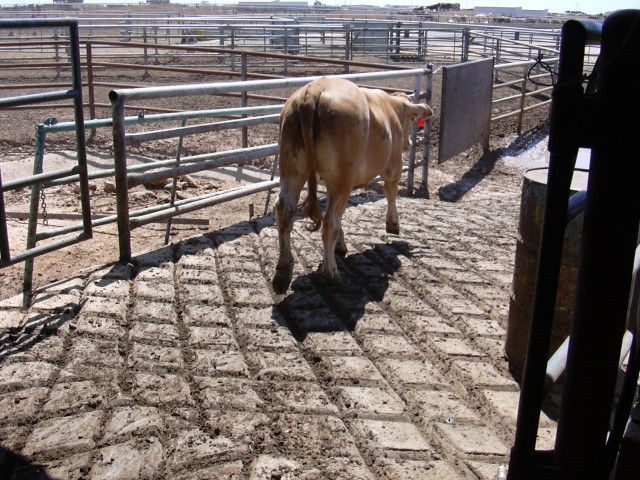
39. Deeply grooved concrete should be used only in crowd pens, single-file chutes, curved lanes, loading ramps, and in front of the squeeze chute. Deeply grooved concrete is not for areas where cattle live. In sorting pens, stock yards, and holding pens that have concrete floors, a shallow 1-inch (2.5cm) groove is recommended. www.grandinlivestockhandlingsystems.com
39
39. Deeply grooved concrete should be used only in crowd pens, single-file chutes, curved lanes, loading ramps, and in front of the squeeze chute. Deeply grooved concrete is not for areas where cattle live. In sorting pens, stock yards, and holding pens that have concrete floors, a shallow 1-inch (2.5cm) groove is recommended. www.grandinlivestockhandlingsystems.com
40. Some people have asked if this rough surface will cause will cause foot bruises. It does not often cause a problem, but to prevent any bruising, lay down 1-inch (2.5cm) of sand on the grooves before using the facility. Let it stay for a few days of use. The sand and the feet of cattle will smooth over any rough edges. Calm handling methods will prevent foot bruising. Calm cattle are less likely to become agitated and hurt their feet by running across grooved concrete. www.grandinlivestockhandlingsystems.com
40
40. Some people have asked if this rough surface will cause foot bruises. It does not often cause a problem, but to prevent any bruising, lay down 1-inch (2.5cm) of sand on the grooves before using the facility. Let it stay for a few days of use. The sand and the feet of cattle will smooth over any rough edges. Calm handling methods will prevent foot bruising. Calm cattle are less likely to become agitated and hurt their feet by running across grooved concrete. www.grandinlivestockhandlingsystems.com
41. To build the catwalk, cut outrigger posts from 2 7/8-inch (7.3cm) OD fence posts that are 26-inches (66cm) long. Saddle cut one end of the outrigger pipe and cap the other end. Weld the outrigger pipe to the 2 7/8-inch (7.3cm) OD fence posts in the crowd pen, placing the top of the outrigger pipe 42-inches (107cm) down from the top of the fence.  www.grandinlivestockhandlingsystems.com
41
41. To build the catwalk, cut outrigger posts from 2 7/8-inch (7.3cm) OD fence posts that are 26-inches (66cm) long. Saddle cut one end of the outrigger pipe and cap the other end. Weld the outrigger pipe to the 2 7/8-inch (7.3cm) OD fence posts in the crowd pen, placing the top of the outrigger pipe 42-inches (107cm) down from the top of the fence. www.grandinlivestockhandlingsystems.com
42. Frame the catwalk with 1 ¼-inch x 1 ¼-inch x 3/8-inch angle iron by cutting notches in the angle iron at each post. Start the framing by welding the angle iron to the outriggers closest to the fence. Cut sections of 3-lb Grade X (expanded metal mesh) into sections 4-feet (1.2m) long and 2-feet (0.6m) wide, and lay them one by one on top of the outrigger posts. Push the expanded metal mesh flush with the inside 1 ¼- inch angle iron frame and trim and trim the mesh along the center line of the outrigger post. Cut and trim these expanded metal mesh sections and frame the outside with 1 1/4-inch angle iron by notching the angle iron at each outrigger post. Spot weld the expanded metal mesh to the 1 ¼-inch frame on the inside and outside. Because people use these walkways, do not use lighter materials as they might break and result in injury to the handler. www.grandinlivestockhandlingsystems.com
42
42. Frame the catwalk with 1 ¼-inch x 1 ¼-inch x 3/8-inch angle iron by cutting notches in the angle iron at each post. Start the framing by welding the angle iron to the outriggers closest to the fence. Cut sections of 3-lb Grade X (expanded metal mesh) into sections 4-feet (1.2m) long and 2-feet (0.6m) wide, and lay them one by one on top of the outrigger posts. Push the expanded metal mesh flush with the inside 1 ¼- inch angle iron frame and trim and trim the mesh along the center line of the outrigger post. Cut and trim these expanded metal mesh sections and frame the outside with 1 1/4-inch angle iron by notching the angle iron at each outrigger post. Spot weld the expanded metal mesh to the 1 ¼-inch frame on the inside and outside. Because people use these walkways, do not use lighter materials as they might break and result in injury to the handler. www.grandinlivestockhandlingsystems.com
43. Optional raised concrete walkway around the crowd pen. An 18-inch high curb was poured against the outside of the fence so the dirt used as an earthen berm was not against the solid steel of the fence. www.grandinlivestockhandlingsystems.com
43
43. Optional raised concrete walkway around the crowd pen. An 18-inch high curb was poured against the outside of the fence so the dirt used as an earthen berm was not against the solid steel of the fence. www.grandinlivestockhandlingsystems.com
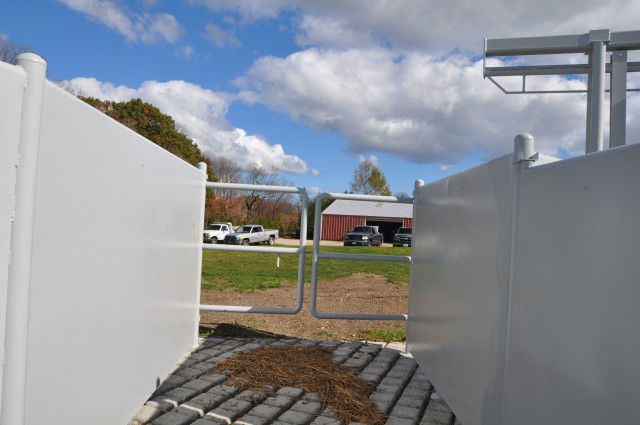
44. Stock trailer and large truck loading ramp attached to the 12-foot (3.5m) crowd pen. A portable ramp is used when a seldom used semi-truck is used to haul cattle. www.grandinlivestockhandlingsystems.com
44
44. Stock trailer and large truck loading ramp attached to the 12-foot (3.5m) crowd pen. A portable ramp is used when a seldom used semi-truck is used to haul cattle. www.grandinlivestockhandlingsystems.com
45. The end of the stock trailer is 66-inches wide and has two 36-inch (0.9m) long wing gates. The wing gates are chained to the sides of the trailer to prevent cattle from squeezing through the gap between the chute and the trailer. www.grandinlivestockhandlingsystems.com45
45. The end of the stock trailer is 66-inches wide and has two 36-inch (0.9m) long wing gates. The wing gates are chained to the sides of the trailer to prevent cattle from squeezing through the gap between the chute and the trailer. www.grandinlivestockhandlingsystems.com
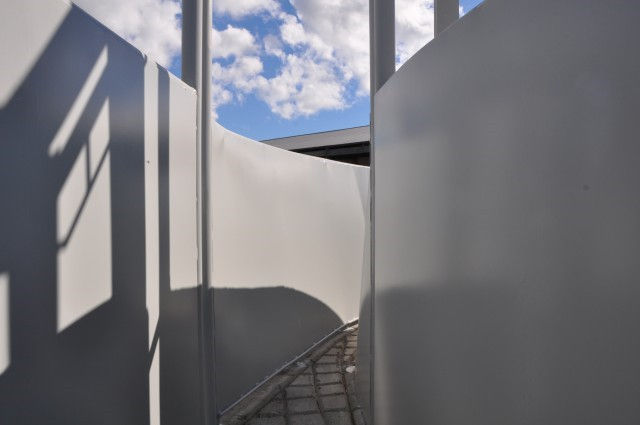
46. A 12-foot (3.5m) selector gate opens across the crowd pen to direct cattle into the loading chutes. An 8-foot (2.4m) selector gate directs cattle to either the stock trailer chute, or as shown in this photo, the large truck loading chute. www.grandinlivestockhandlingsystems.com
46
46. A 12-foot (3.5m) selector gate opens across the crowd pen to direct cattle into the loading chutes. An 8-foot (2.4m) selector gate directs cattle to either the stock trailer chute, or as shown in this photo, the large truck loading chute. www.grandinlivestockhandlingsystems.com
47. The entrance from the crowd pen to the single file chute is 30-inches (76.2cm) wide. The slide gate is located at this junction. www.grandinlivestockhandlingsystems.com
47
47. The entrance from the crowd pen to the single file chute is 30-inches (76.2cm) wide. The slide gate is located at this junction. www.grandinlivestockhandlingsystems.com
48. An 18-inch (45cm) opening in the solid fence of the crowd pen. www.grandinlivestockhandlingsystems.com
48
48. An 18-inch (45cm) opening in the solid fence of the crowd pen. www.grandinlivestockhandlingsystems.com
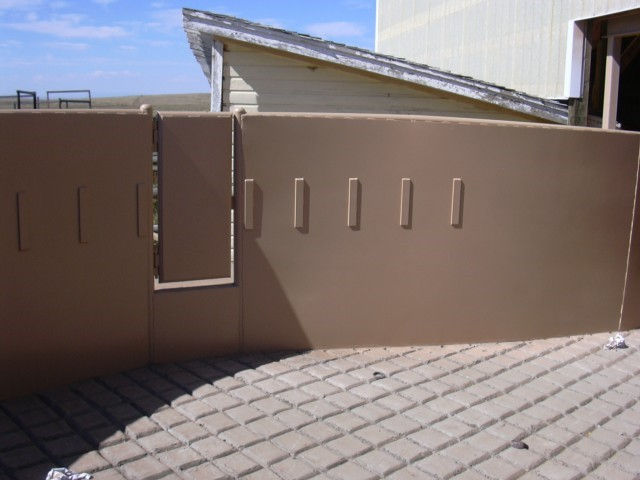
49. An 18-inch (45cm) man gate (handler gate) in the crowd pen. The gate has springs to keep it shut. www.grandinlivestockhandlingsystems.com
49
49. An 18-inch (45cm) man gate (handler gate) in the crowd pen. The gate has springs to keep it shut. www.grandinlivestockhandlingsystems.com
50. A handler pushes the crowd gate past the handler gate, the steps out onto the catwalk along the outside of the crowd pen. The ratchet latch on the crowd gate catches on the metal strips welded to the crowding pen wall. Ratchet cogs 12-inches (304cm) apart. Cogs: 3/8-inch (9.5) thick, 2-inches (50cm) wide, and 12-inches (304cm) apart. See details for ratchet latch on page 173 of the Humane Livestock Handling book.  www.grandinlivestockhandlingsystems.com50
50. A handler pushes the crowd gate past the handler gate, the steps out onto the catwalk along the outside of the crowd pen. The ratchet latch on the crowd gate catches on the metal strips welded to the crowding pen wall. Ratchet cogs 12-inches (304cm) apart. Cogs: 3/8-inch (9.5) thick, 2-inches (50cm) wide, and 12-inches (304cm) apart. See details for ratchet latch on page 173 of the Humane Livestock Handling book. www.grandinlivestockhandlingsystems.com
51. Gate opens in the direction of cattle movement. Cap the top of all upright posts.  www.grandinlivestockhandlingsystems.com
51
51. Gate opens in the direction of cattle movement. Cap the top of all upright posts. www.grandinlivestockhandlingsystems.com
52. Spring loaded man gate opening in to the crowding pen. www.grandinlivestockhandlingsystems.com
52
52. Spring loaded man gate opening in to the crowding pen. www.grandinlivestockhandlingsystems.com
53. 18-inch (45cm) man gate in 60-inch (1.5m) high solid fence.  www.grandinlivestockhandlingsystems.com
53
53. 18-inch (45cm) man gate in 60-inch (1.5m) high solid fence. www.grandinlivestockhandlingsystems.com
54. Double 18-inch (45cm) man gates in cattle alley leading to the wide curved lane. A block gate latches to the strike post in the center of the gates. A slam latch is used for handler safety. The handler walks behind the cattle in the alley and blocks the cattle from turning back by slamming the gate. The handler can then step out one gate and into the alley through the other. The slam latch prevents cattle from pushing the gate back on people. www.grandinlivestockhandlingsystems.com
54
54. Double 18-inch (45cm) man gates in cattle alley leading to the wide curved lane. A block gate latches to the strike post in the center of the gates. A slam latch is used for handler safety. The handler walks behind the cattle in the alley and blocks the cattle from turning back by slamming the gate. The handler can then step out one gate and into the alley through the other. The slam latch prevents cattle from pushing the gate back on people. www.grandinlivestockhandlingsystems.com
55. Pipe and rail fence. A 5-rail fence is recommended on ranches to prevent calves from going through the fence. In a feed yard pen holding large cattle, a 4-rail fence is all that is needed. www.grandinlivestockhandlingsystems.com
55
55. Pipe and rail fence. A 5-rail fence is recommended on ranches to prevent calves from going through the fence. In a feed yard pen holding large cattle, a 4-rail fence is all that is needed. www.grandinlivestockhandlingsystems.com
56. A 5-rail fence in a cattle alley using a 2-inch (5cm) top rail and sucker rod for rails. The alley is 12-feet (3.5m) wide. The gate on the right side is 14-feet (4.2m) long and opens on an angle across the alley preventing a 90-degree turn. www.grandinlivestockhandlingsystems.com
56
56. A 5-rail fence in a cattle alley using a 2-inch (5cm) top rail and sucker rod for rails. The alley is 12-feet (3.5m) wide. The gate on the right side is 14-feet (4.2m) long and opens on an angle across the alley preventing a 90-degree turn. www.grandinlivestockhandlingsystems.com
57. A 5-rail fence prevents calves from climbing through the fence.  www.grandinlivestockhandlingsystems.com
57
57. A 5-rail fence prevents calves from climbing through the fence. www.grandinlivestockhandlingsystems.com
58. A three-way gate system at the intersection between two alleys. The three-way gate system allows cattle to see a place to go and prevents a 90-degree turn. www.grandinlivestockhandlingsystems.com
58
58. A three-way gate system at the intersection between two alleys. The three-way gate system allows cattle to see a place to go and prevents a 90-degree turn. www.grandinlivestockhandlingsystems.com
59. The gates for a three-way gate system are hinged on separate posts. The posts are welded together with rails for stability. www.grandinlivestockhandlingsystems.com
59
59. The gates for a three-way gate system are hinged on separate posts. The posts are welded together with rails for stability. www.grandinlivestockhandlingsystems.com
60. The back-stop one way gate in this photograph is counterweighted. The counterweight makes the gate so light, cattle have to barely touch it to open it. The gate is mounted in the single-file chute and should be adjusted so the bottom of the gate is in the middle of the animal?s rear end when the animal backs against it. www.grandinlivestockhandlingsystems.com
60
60. The back-stop one way gate in this photograph is counterweighted. The counterweight makes the gate so light, cattle have to barely touch it to open it. The gate is mounted in the single-file chute and should be adjusted so the bottom of the gate is in the middle of the animal?s rear end when the animal backs against it. www.grandinlivestockhandlingsystems.com
61. Palpation gates behind the squeeze chute for pregnancy testing and artificial insemination. It is important that the palpation gates have sturdy latches for both the open and closed position. You'll need to latch these gates when they're open to prevent cattle in the single-file chute from pushing on the person doing the palpation or the procedure from escaping through the gate. www.grandinlivestockhandlingsystems.com
61
61. Palpation gates behind the squeeze chute for pregnancy testing and artificial insemination. It is important that the palpation gates have sturdy latches for both the open and closed position. You'll need to latch these gates when they're open to prevent cattle in the single-file chute from pushing on the person doing the palpation or the procedure from escaping through the gate. www.grandinlivestockhandlingsystems.com
62. Palpation gates behind the squeeze chute for pregnancy testing and artificial insemination. www.grandinlivestockhandlingsystems.com
62
62. Palpation gates behind the squeeze chute for pregnancy testing and artificial insemination. www.grandinlivestockhandlingsystems.com
63. Palpation gates must be solid sided to block the vision of the cattle standing in the single-file chute and prevent them from seeing people near the squeeze chute when they are in the closed position. www.grandinlivestockhandlingsystems.com
63
63. Palpation gates must be solid sided to block the vision of the cattle standing in the single-file chute and prevent them from seeing people near the squeeze chute when they are in the closed position. www.grandinlivestockhandlingsystems.com
64. The slide gate is located where the single-file chute begins. The gate rolls on a piece of inverted angle iron that is welded to the framework. The rollers are Bassick 4-inch semi steel v-grooved wheels that can be purchased through Grainger Industrial Supply Company: (grainger.com). www.grandinlivestockhandlingsystems.com64
64. The slide gate is located where the single-file chute begins. The gate rolls on a piece of inverted angle iron that is welded to the framework. The rollers are Bassick 4-inch semi steel v-grooved wheels that can be purchased through Grainger Industrial Supply Company: (grainger.com). www.grandinlivestockhandlingsystems.com
65. The slide must have open bars to facilitate cattle following behavior; cattle standing in the crowd pen can see other animals in the single-file chute and will approach even if the sliding gate is closed. www.grandinlivestockhandlingsystems.com
65
65. The slide must have open bars to facilitate cattle following behavior; cattle standing in the crowd pen can see other animals in the single-file chute and will approach even if the sliding gate is closed. www.grandinlivestockhandlingsystems.com
66. The slide gate rolls through a slot in the floor of the raised concrete platform or through a slot if a catwalk (handler walkway) is installed instead of a raised platform. www.grandinlivestockhandlingsystems.com
66
66. The slide gate rolls through a slot in the floor of the raised concrete platform or through a slot if a catwalk (handler walkway) is installed instead of a raised platform. www.grandinlivestockhandlingsystems.com
67. The funnel from the crowd pen into the single file is designed to be 30 degrees. This angle is important to prevent two cattle from trying to enter the single-file chute at the same time. The distance between the posts supporting the slide gate are 30-inches (7.62cm) apart. www.grandinlivestockhandlingsystems.com67
67. The funnel from the crowd pen into the single file is designed to be 30 degrees. This angle is important to prevent two cattle from trying to enter the single-file chute at the same time. The distance between the posts supporting the slide gate are 30-inches (7.62cm) apart. www.grandinlivestockhandlingsystems.com
68. Slam latch on block gate in cattle alley latches automatically when the gate is closed. Slam latches can be difficult to build, and it is often best to purchase them from a commercial manufacturer. The slam latch in this picture can be purchased from AMOS Arena Products: (amos-arenas.com).  www.grandinlivestockhandlingsystems.com
68
68. Slam latch on block gate in cattle alley latches automatically when the gate is closed. Slam latches can be difficult to build, and it is often best to purchase them from a commercial manufacturer. The slam latch in this picture can be purchased from AMOS Arena Products: (amos-arenas.com). www.grandinlivestockhandlingsystems.com
69. Slam latches can prevent injuries to handlers from cattle pushing gates back into them. www.grandinlivestockhandlingsystems.com
69
69. Slam latches can prevent injuries to handlers from cattle pushing gates back into them. www.grandinlivestockhandlingsystems.com
70. When building the channel iron hinge, cut a hole in the channel and weld the pipe sleeve to the bottom of the channel. The gate must not pivot against the welding bead.  www.grandinlivestockhandlingsystems.com
70
70. When building the channel iron hinge, cut a hole in the channel and weld the pipe sleeve to the bottom of the channel. The gate must not pivot against the welding bead. www.grandinlivestockhandlingsystems.com
71. Weld the 3-inch (8cm) wide channel gate hinge to the post. www.grandinlivestockhandlingsystems.com
71
71. Weld the 3-inch (8cm) wide channel gate hinge to the post. www.grandinlivestockhandlingsystems.com
72. The pipe that forms the gate frame will fit over the 2-inch (5cm) pipe sleeve welded to the channel iron. www.grandinlivestockhandlingsystems.com
72
72. The pipe that forms the gate frame will fit over the 2-inch (5cm) pipe sleeve welded to the channel iron. www.grandinlivestockhandlingsystems.com
73. Place the inner sleeve of the top hinge into the top of the gate and line it up in the same position on the post as the bottom hinge. (Note: For expansion, it is a good idea to leave a small space between the bottom of the channel iron hinge and the top of the gate post). Weld the top and bottom of the channel iron hinges securely to the gate post. www.grandinlivestockhandlingsystems.com
73
73. Place the inner sleeve of the top hinge into the top of the gate and line it up in the same position on the post as the bottom hinge. (Note: For expansion, it is a good idea to leave a small space between the bottom of the channel iron hinge and the top of the gate post). Weld the top and bottom of the channel iron hinges securely to the gate post. www.grandinlivestockhandlingsystems.com
74. A channel iron hinge can also be attached to a wooden gate post with bolts on large lag screws. www.grandinlivestockhandlingsystems.com
74
74. A channel iron hinge can also be attached to a wooden gate post with bolts on large lag screws. www.grandinlivestockhandlingsystems.com
75. Horseback gate latch. This latch can be used on all gates except small handler gates and overlapping gates across a wide alley. Our Humane Livestock Handling has detail drawings for the horseback latch and others. www.grandinlivestockhandlingsystems.com75
75. Horseback gate latch. This latch can be used on all gates except small handler gates and overlapping gates across a wide alley. Our Humane Livestock Handling has detail drawings for the horseback latch and others. www.grandinlivestockhandlingsystems.com
76. The solid sides and level dock on this ramp minimize stress for cattle. The level dock provides cattle with a flat surface to walk on when they exit the truck.  www.grandinlivestockhandlingsystems.com
76
76. The solid sides and level dock on this ramp minimize stress for cattle. The level dock provides cattle with a flat surface to walk on when they exit the truck. www.grandinlivestockhandlingsystems.com
77. Self aligning dock bumper is designed to insure that there is no gap between the dock and the truck that cattle can get a foot stuck in. www.grandinlivestockhandlingsystems.com
77
77. Self aligning dock bumper is designed to insure that there is no gap between the dock and the truck that cattle can get a foot stuck in. www.grandinlivestockhandlingsystems.com
78. On concrete ramps, stair steps with a 3 ½-to 4-inch (9 to 10cm) rise and a 12-to18-inch (30 to 46cm) tread length are recommended. Stair steps work better than grooved concrete ramps because when they become worn, cattle can still walk on them without slipping. www.grandinlivestockhandlingsystems.com
78
78. On concrete ramps, stair steps with a 3 ½-to 4-inch (9 to 10cm) rise and a 12-to18-inch (30 to 46cm) tread length are recommended. Stair steps work better than grooved concrete ramps because when they become worn, cattle can still walk on them without slipping. www.grandinlivestockhandlingsystems.com
79. Ramp angles should not exceed 20-degrees. www.grandinlivestockhandlingsystems.com
79
79. Ramp angles should not exceed 20-degrees. www.grandinlivestockhandlingsystems.com
80. Install handler steps on the side that best suits your needs. They may be either concrete or steel and must comply with OSHA (Occupational Safety and Health Act) standards, which can be accessed at the U.S. Department of Labor OSHA site on the internet or www.osha.gov. www.grandinlivestockhandlingsystems.com
80
80. Install handler steps on the side that best suits your needs. They may be either concrete or steel and must comply with OSHA (Occupational Safety and Health Act) standards, which can be accessed at the U.S. Department of Labor OSHA site on the internet or www.osha.gov. www.grandinlivestockhandlingsystems.com
81. An 8-foot (2.4m) selector gate directs cattle to either the stock trailer loading area, or into a ramp leading to a large truck loading dock. www.grandinlivestockhandlingsystems.com
81
81. An 8-foot (2.4m) selector gate directs cattle to either the stock trailer loading area, or into a ramp leading to a large truck loading dock. www.grandinlivestockhandlingsystems.com
82. There are many good squeeze chutes on the market, both manual and hydraulic. This hydraulic chute has easy to operate controls mounted at waist height. www.grandinlivestockhandlingsystems.com82
82. There are many good squeeze chutes on the market, both manual and hydraulic. This hydraulic chute has easy to operate controls mounted at waist height. www.grandinlivestockhandlingsystems.com
     
©2011 Grandin Livestock Handling Systems, Inc. All rights reserved. Website Design by Zooma Design, LLC.